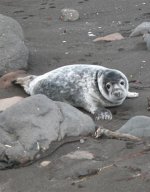
 The grey seal (Halichoerus grypus) is a big "true" seal, the largest British Isles native mammal, that is the one and only classified species of the Halichoerus genus of the Phocidae family. It is found in subarctic and temperate shores on both sides of the North Atlantic ocean. There are three specified populations of this seal: the western Atlantic population found in Canadian maritime provinces from Cape Chidley on Labrador coast and extends to Nova Scotia; the population on eastern Atlantic on the British Isles and Faeroe Islands up to Iceland southwestern coasts; and the Baltic Sea population.
 The grey seal's habitat varies among individual groups. Some are found along the coasts of rocky continental areas, while some are seen on solitary islands. There are populations on ice shelves and icebergs, too.
A grey seal bull can be 2.5 to 3.3 meters in length and almost 300 kilograms in weight. A cow is much smaller, about 1.6 to 2 meters in length and weighing around 100 to 150 kilograms. Pups already weigh about 16 kilograms when born. They become even fatter thanks to their mothers' milk, and they will gain mass four times more by the time they reach moulting period. Sex differentiation by color will manifest at this stage. The female has a grey-silver colour with dark spots scattered all over its body.
Grey seals eat usually by groups. They devour a lot of fish like sand eels cod, herring, flatfish, and skates. They also eat lobsters and octopus and other sea creatures. It is said that they need to eat about 5 kilograms of food everyday although they do not eat daily, and they actually go into fasting when breeding.
Keywords: white
Which zoos have them?
Los Angeles Zoo (United States) and Smithsonian National Zoological Park (United States)The Gray seal, grey seal is listed as Least Concern (LR/lc), lowest risk. Does not qualify for a more at risk category. Widespread and abundant taxa are included in this category, on the IUCN Red List of Threatened Species
Namings for the gray seal
A young / baby of a gray seal is called a 'pup'. The females are called 'cow' and males 'bull'. A gray seal group is called a 'pod, colony, crash, flock, harem, bob, herd, rookery, team or hurd'.Countries
Canada, Estonia, Faroe Islands, Finland, France, Germany, Iceland, Ireland, Latvia, Lithuania, Norway, Poland, Russia, Sweden and United KingdomSome facts about the
Gray seal
Adult weight : 268 kg (589.6 lbs)
Maximum longevity : 43 years
Female maturity :1460 days
Male maturity : 1887 days
Gestation : 240 days
Weaning : 19 days
Litter size : 1
Litters per year : 1
Interval between litters : 365 days
Weight at birth : 14 kg (30.8 lbs)
Weight at weaning : 41.45 kg (91.19 lbs)
