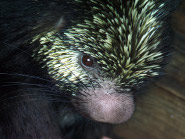
 The Mexican Hairy Dwarf Porcupine or Tree Porcupine (Sphiggurus mexicanus) is a rodent that is found in many Latin American countries and surrounding areas, such as (as its name indicates) Mexico, Guatemala, Honduras, Costa Rica, Panama, and possibly two other locations. It is not classed as endangered, and is in fact classed 'least concern' due to its abundance and population. Adult Mexican Hairy Dwarf Porcupines range in size from 20 to 32 inches (that's roughly 54.61 cm to 81.28 cm) in lengths with a long tail that is from anywhere around one third to two fifths of its total body length. They usually weight about 3.2 to 5.5 lbs (1.4 to 2.48 kg) and have dark fur, usually brown to black in color that covers most of their spines which in turn are present across the porcupine’s back. The head is usually marked by yellow or pale color spines that are visible through the fur itself, and also by light pale colored fur fuzz around the ears. The long tail has almost no fur and is prehensile (meaning it can be used rather than just for balance) and resembles a large rat tail.
The Mexican Hairy Dwarf Porcupine's scientific classification name is Sphiggurus Mexicanus, which means its species is Mexicanus and its genus is Sphiggurus. Within the genus Sphiggurus there are eight other species of porcupine, and all live in the western hemisphere. They belong to the subfamily Erethizontinae, which in turn belongs to the family Erthizontidae, which has five Genera. These are different than the Old World porcupine (Eastern Hemisphere), and thus are called New World (Western Hemisphere) porcupine. In turn this family belongs to the parvorder Caviomorpha, which contains many other families (twelve living, three known extinct) and contain such animals as Chinchillas, Capybaras, and many more. Caviomorpha belongs to the infraorder Hystricognathi, which belongs to the suborder Hystricomorpha. Hystricomorpha is a huge selection of rodents; however it belongs to the order Rodentia, which contains all rodents – which makes up roughly 40% of all mammalian species – with 2,277 knowing living examples.
Their weapon, the quill, is a primarily defensive one, in which the specialized hairs are extremely sharp and detach easily. The quill, once embedded in flesh, will continue to go inward, as each quill has microscopic fibers that are pointed away from the tip toward the other end. The quills themselves can reach up to three inches in length, and make for a painful removal due to their microscopically barbed nature. A common misconception is that a porcupine can 'fire' a quill at you – this is not true as contact must be made for the quill to stick, and there is no mechanism for flinging a quill except for a minor shaking for grooming reasons.
Interesting Fact
Porcupines love salt, in fact many have been found causing chaos by chewing on wires under a car which have been coated with road salt, getting into cabinets for salty chips, and even eating plywood that has been treated with sodium nitrates. Often times areas with porcupine populations will place salt licks out of the way so that they do not get in trouble.
Picture of the Mexican hairy dwarf porcupine by Patrick Gijsbers, licensed under GFPL
The Mexican hairy dwarf porcupine, mexican tree porcupine is listed as Least Concern (LR/lc), lowest risk. Does not qualify for a more at risk category. Widespread and abundant taxa are included in this category, on the IUCN Red List of Threatened Species
Namings for the Mexican hairy dwarf porcupine
A young / baby of a Mexican hairy dwarf porcupine is called a 'pup'. The females are called 'sow' and males 'boar'. A Mexican hairy dwarf porcupine group is called a 'prickle or family'.Some facts about the
Mexican tree porcupine
Adult weight : 2 kg (4.4 lbs)
Maximum longevity : 17 years
Litter size : 1

Custom Search