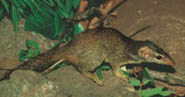
 The Madras Treeshrew (Anathana ellioti), also known as the Indian Treeshrew, is a small mammal that lives in the hilly forests of southern India. It is related to the other treeshrews; however it is in a different Family, and is monotypic (only one kind). The Madras Treeshrew is omnivorous, and has the same kind of unspecified molars as the other Treeshrews in the order Scandentia. They resemble most other treeshrews, however have larger ears, and also are speckled brown, yellow or black over their fur. The main body of fur usually has a reddish tinge and the ventral area is white most of the time - although all these colorations will vary from individual to individual. They are usually 16-18 centimeters in length (6-7 inches) and the tail is usually that same length making the total length about 32-36 (13-17 inches long). On average they will weigh about 160 grams (5 and a half ounces) although larger specimens have been recorded.
 The habitat of the Madras Treeshrew is that of a partially moist to very moist forest habitat, with deciduous trees and shrubs making up the forest floor. However, they can also be found in the southern India slopes, and ravines, along with cultivated fields or pastures. They have proven to adapt to surrounding if the conditions are right and feast on the abundance of insect life in their chosen areas.
Although the Madras Treeshrew has the word tree in its name, it is in fact uncommon to see one climb a tree, and when they do climb a tree it is usually a means of escape, or of play with younger Treeshrews, and maybe the rare exception of a safe place to self-groom - and to do this they will climb the tree, and then slide down it stretched out. They will repeat this at every angle until they feel sufficiently groomed. The majority of time is spent hidden on the forest floors, travelling specially made ‘roads’ under the brush, and inspecting their territories or looking for some insects or seeds to eat.
Madras Treeshrews also like to build night shelters between soft ground and stones, which can be very complex or very simple. They rarely house more than one, as the treeshrew in general is a solitary species, with the Madras Treeshrew being one that is paired only during certain times of the year if at all. The behavior in regards to mating is not well known, however due to studies of their biology it is assumed that they can produce up to five young at a time. If they are at all similar to other treeshrews they may only spend a short time with their young, and their young will mature rapidly, leaving the nest in three to five months.
A few facts about the Madras Treeshrews
- The Madras Treeshrew can be seen as similar to the squirrel, however a difference is that the treeshrew will walk with its tail in an upward curve and a curl that continues that - unlike the squirrel who’s tail does start going up, but curls the opposite direction.
- The name Anathana ellioti in which Anathana is the genus comes from the Tamil words Moongil Anathaan, which has the meaning of ‘Bamboo Squirrel’ while ellioti, the species name, comes from the man who first documented the species - Sir Walter Elliot.
- The Madras Treeshrew mostly forages in the morning, rather than the evening, as an advantage over other foragers who start later in the day.
Picture of the Madras tree shrew was photographed by S. Karthikeyan in Yercaud, India, licensed under GFDL
The Madras tree shrew is listed as Near Threatened (LR/nt), is close to qualifying for or is likely to qualify for a threatened category in the near future, on the IUCN Red List of Threatened Species
Countries
India
Custom Search