Subscribe to
"Animal of the day"

AddThis Feed Button
Or subscribe by e-mail

Enter your Email


Powered by FeedBlitz

We hope that reader will gain an increased appreciation of the need for more conservation measure in order to protect the beautiful creatures that inhabit the earth. Our philosophy is that the more we learn about animals, the more we respect them and take better care of them. That is why we update this blog with new animals, We encourage you to syndicate our content by adding "animal of the day" to your own blog! (read more)

About us

Our mission is to get people excited about animals and their welfare by writing articles on these animals. We encourage people to comment on posts and share with others. Don't forget to subscribe to our feed.

Contact us
Copyright notice

Funny animal videos and pictures

Swimming with manatees - harmful or helpful

Last Comments

Erik (Narwhal - The Wha…): Awesome! I had not heard …
Matty (Pudu - smallest d…): Look, I know they are cut…
Doro (Fattest cat in th…): check out fat-animals.com…
dylan barker (Pink fairy armadi…): i acctually think that th…
Lindsay (Fattest cat in th…): this cat is not to fat my…
Tima (Bottlenose dolphi…): J. David Smith, Ph.D., a …
Coda Plant (Pudu - smallest d…): Hey. I live in Northern C…
Michael Newton (Koala video): i love you mr. koala
Tohru (Asian Golden Cat): I hate them too! They are…
tiffany (Asian Golden Cat): i love this cat i’m doing…

Calendar

« November 2009
S M T W T F S
1 2 3 4 5 6 7
8 9 10 11 12 13 14
15 16 17 18 19 20 21
22 23 24 25 26 27 28
29 30          

Archives

Next Archive Previous Archive

01 Nov - 30 Nov 2009
01 Oct - 31 Oct 2009
01 Sep - 30 Sep 2009
01 Aug - 31 Aug 2009
01 Jul - 31 Jul 2009
01 Jun - 30 Jun 2009
01 May - 31 May 2009
01 Apr - 30 Apr 2009
01 Mar - 31 Mar 2009
01 Feb - 28 Feb 2009
01 Jan - 31 Jan 2009
01 Dec - 31 Dec 2008
01 Nov - 30 Nov 2008
01 Oct - 31 Oct 2008
01 Sep - 30 Sep 2008
01 Jul - 31 Jul 2008
01 Jun - 30 Jun 2008
01 May - 31 May 2008
01 Apr - 30 Apr 2008
01 Mar - 31 Mar 2008
01 Feb - 28 Feb 2008
01 Jan - 31 Jan 2008
01 Dec - 31 Dec 2007
01 Nov - 30 Nov 2007
01 Oct - 31 Oct 2007
01 Sep - 30 Sep 2007
01 Aug - 31 Aug 2007
01 Jul - 31 Jul 2007
01 Jun - 30 Jun 2007
01 May - 31 May 2007
01 Apr - 30 Apr 2007
01 Mar - 31 Mar 2007
01 Feb - 28 Feb 2007
01 Jan - 31 Jan 2007
01 Dec - 31 Dec 2006
01 Nov - 30 Nov 2006
01 Oct - 31 Oct 2006
01 Sep - 30 Sep 2006
01 Aug - 31 Aug 2006
01 Jul - 31 Jul 2006
01 Jun - 30 Jun 2006
01 May - 31 May 2006
01 Apr - 30 Apr 2006
01 Mar - 31 Mar 2006
01 Feb - 28 Feb 2006
01 Jan - 31 Jan 2006
01 Dec - 31 Dec 2005
01 Sep - 30 Sep 2005
01 Aug - 31 Aug 2005
01 Jul - 31 Jul 2005

Animal posters
Animal pictures
Mammals.start4all.com
Animal diversity web
Recently extinct animals forum
PetLvr.com
Another chance to see
Happiness is a warm puppy

Miscellany

AddThis Feed Button

« Nubian Ibex - The Res… | Home | Blue Monkey - A Socia… »

Siberian Chipmunks - Exceptionally Hygienic Omnivores

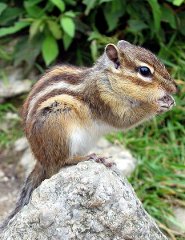
Siberian chipmunkThe Siberian Chipmunk (Tamias sibiricus) is the only member of its genus that lives outside America. Ranging from Russia to China, northern Japan, Korea, and northern Asia, its main habitats include woodlands with thick bushy vegetation.

Its total length from head to tail is 18 to 25 cm (3.93 to 9.84 inches) of which one third is occupied by its tail. The weight of an adult Siberian chipmunk varies according to the season but normally, an adult Siberian chipmunk weighs about 50 to 150 grams (1.76 to 5.29 oz). When compared to its other relatives such as the red squirrel, it is rather smaller in size.

The Siberian chipmunks are omnivorous animals and feed on mushrooms, shrubs, small birds, berries, and small animals. Their diet includes conifer seeds, nuts, and vegetables and they also eat tree buds, wheat, buckwheat, and oats. Chipmunks also prey lizards and insects. Mustelids, cats, and birds are the main predators of the Siberian chipmunk. This species can prove dangerous since it can spread grave diseases like rabies by its bite. Siberian chipmunks have made colonies in some parts of central and Eastern Europe, since they escape easily from captivity.

In some parts of Europe, the Siberian chipmunk is being kept as a pet but it needs a very spacious place for climbing and the place should be covered properly to avoid retreat. They are not much active during winters but generally avoid sleeping for a long time in heated rooms. Their lifespan is short in the wild but in captivity, they can survive for more than 10 years. It is a universal fact that animals born in captivity become disciplined to some extent. The Siberian chipmunk generally enjoys feeding on vegetables, fruits, rodent lab-blocks and nuts.

Like its relatives, it has bright colored fur with dark stripes, and large pouches in its cheeks to collect food. Its ears are small and rounded up at the ends. The color of its fur depends on the origin of the animal. The fur is brown grey or tawny yellow. Along its flanks there are five dark and four light colored long stripes. The color of its tail is light brown and there are thick black lines on both sides with small white edges.

They mainly live in forests. Their needle-pointed claws make them a superb climber but most of the time, they stays on the ground. They construct lodges on the ground to live in and in order to store food, the Siberian chipmunks bury their food 5 to 7 cm under the ground. They are hygienic and clean themselves from head to tail. Sometimes, they even clean one another. They make various sounds including a bird-like 'cheep' short whistle which lasts only for 1 or 2 seconds. They make this sound 5 to 6 times constantly when they smell any danger. They are most active during the day time.


Add your thoughts about this animal:

You can help spreading the word about this animal by stumbling it by pressing this link StumbleUpon or
  
Remember personal info?

Emoticons / Textile

To be able to comment you are asked to answer this silly question. This question baffles automated spam bots, but fortunately for you it is a simple question, i hope.
 

  ( Register your username / Log in )

Notify:
Hide email:

Small print: All html tags except <b> and <i> will be removed from your comment. You can make links by just typing the url or mail-address.
Animal of the Day
Subscribe to the
animal of the day
Enter your Email


Powered by FeedBlitz

Add "Animal of the day" to your blog

A new feature has been set up for your
site: "Animal of the Day", you can add this to your website by copying the code. An example of how
this would look like and the code to be added can be found here.

63 comments - Permanent Link