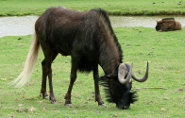
 The black wildebeest (Connochaetes gnou) is one of two species of wildebeest; the other is, of course, the more numerous blue wildebeest - well known from natural history documentaries, roaming across the Serengeti. It might surprise you to learn that wildebeest, both the blue and black species, are actually a type of antelope.
The name ‘black' wildebeest is something of a misnomer, as the coat of this species can more accurately be described as ranging from chocolate to very dark brown in color. Its alternative name, the white-tailed gnu, is perhaps better in that it describes the most striking feature of this species; the long white tail. In common with many mammals, the quality of a black wildebeest's coat changes seasonally, becoming thicker in winter; this is clearly a homeostatic adaptation, aiding the maintenance of a stable body temperature.
Black wildebeest are herbivorous. Indeed, their diet is not very varied; consisting almost exclusively of grass. However, black wildebeest are highly sought after components of other animals' diets, with their main predators including: spotted hyenas, leopards, cheetahs, lions and crocodiles. Considering black wildebeests weigh in at anything up to 180 kilograms (that's nearly 400lbs), they are quite a meal for a successful hunter but by no means an easy one.
The black wildebeest breeding season starts in February and ends in April each year. They have a gestation period of just over eight months, with mothers generally giving birth to a single calf in either November or December. The young are weaned after four months but will only reach sexual maturity after about two years for females and three years for males. Black wildebeest can live for up to 20 years.
While, the current conservation status of the white-tailed gnu is registered as 'Least Concern', in the recent past their future was much less certain. Indeed, humans, white-settlers in particular, hunted the black wildebeest almost to extinction, and it is thought that all current black wildebeest herds are derived from captive stock rather than natural populations. This is a sad fact in itself, but the currently thriving populations of black wildebeest in north-eastern South Africa serve to highlight the success of captive breeding and release/re-introduction programs.
The reason black wildebeest were so heavily hunted is largely because farmers saw them as pests - the meat was, in many cases, only a by-product of the 'pest' control. Furthermore, the white tails of the black wildebeest were commonly saved for use as fly swats, similar to the way in which the live animal would have used the tail itself.
Keywords: black , white , blue
Which zoos have them?
Artis (Netherlands)The Black wildebeest is listed as Least Concern. Does not qualify for a more at risk category. Widespread and abundant taxa are included in this category, on the IUCN Red List of Threatened Species
Some facts about the
Black wildebeest
Adult weight : 132.25 kg (290.95 lbs)
Maximum longevity : 22 years
Female maturity :763 days
Gestation : 259 days
Weaning : 228 days
Litter size : 1
Weight at birth : 11 kg (24.2 lbs)

Custom Search