Subscribe to
"Animal of the day"

AddThis Feed Button
Or subscribe by e-mail

Enter your Email


Powered by FeedBlitz

We hope that reader will gain an increased appreciation of the need for more conservation measure in order to protect the beautiful creatures that inhabit the earth. Our philosophy is that the more we learn about animals, the more we respect them and take better care of them. That is why we update this blog with new animals, We encourage you to syndicate our content by adding "animal of the day" to your own blog! (read more)

About us

Our mission is to get people excited about animals and their welfare by writing articles on these animals. We encourage people to comment on posts and share with others. Don't forget to subscribe to our feed.

Contact us
Copyright notice

Funny animal videos and pictures

Swimming with manatees - harmful or helpful

Last Comments

Erik (Narwhal - The Wha…): Awesome! I had not heard …
Matty (Pudu - smallest d…): Look, I know they are cut…
Doro (Fattest cat in th…): check out fat-animals.com…
dylan barker (Pink fairy armadi…): i acctually think that th…
Lindsay (Fattest cat in th…): this cat is not to fat my…
Tima (Bottlenose dolphi…): J. David Smith, Ph.D., a …
Coda Plant (Pudu - smallest d…): Hey. I live in Northern C…
Michael Newton (Koala video): i love you mr. koala
Tohru (Asian Golden Cat): I hate them too! They are…
tiffany (Asian Golden Cat): i love this cat i’m doing…

Calendar

« November 2009
S M T W T F S
1 2 3 4 5 6 7
8 9 10 11 12 13 14
15 16 17 18 19 20 21
22 23 24 25 26 27 28
29 30          

Archives

Next Archive Previous Archive

01 Nov - 30 Nov 2009
01 Oct - 31 Oct 2009
01 Sep - 30 Sep 2009
01 Aug - 31 Aug 2009
01 Jul - 31 Jul 2009
01 Jun - 30 Jun 2009
01 May - 31 May 2009
01 Apr - 30 Apr 2009
01 Mar - 31 Mar 2009
01 Feb - 28 Feb 2009
01 Jan - 31 Jan 2009
01 Dec - 31 Dec 2008
01 Nov - 30 Nov 2008
01 Oct - 31 Oct 2008
01 Sep - 30 Sep 2008
01 Jul - 31 Jul 2008
01 Jun - 30 Jun 2008
01 May - 31 May 2008
01 Apr - 30 Apr 2008
01 Mar - 31 Mar 2008
01 Feb - 28 Feb 2008
01 Jan - 31 Jan 2008
01 Dec - 31 Dec 2007
01 Nov - 30 Nov 2007
01 Oct - 31 Oct 2007
01 Sep - 30 Sep 2007
01 Aug - 31 Aug 2007
01 Jul - 31 Jul 2007
01 Jun - 30 Jun 2007
01 May - 31 May 2007
01 Apr - 30 Apr 2007
01 Mar - 31 Mar 2007
01 Feb - 28 Feb 2007
01 Jan - 31 Jan 2007
01 Dec - 31 Dec 2006
01 Nov - 30 Nov 2006
01 Oct - 31 Oct 2006
01 Sep - 30 Sep 2006
01 Aug - 31 Aug 2006
01 Jul - 31 Jul 2006
01 Jun - 30 Jun 2006
01 May - 31 May 2006
01 Apr - 30 Apr 2006
01 Mar - 31 Mar 2006
01 Feb - 28 Feb 2006
01 Jan - 31 Jan 2006
01 Dec - 31 Dec 2005
01 Sep - 30 Sep 2005
01 Aug - 31 Aug 2005
01 Jul - 31 Jul 2005

Animal posters
Animal pictures
Mammals.start4all.com
Animal diversity web
Recently extinct animals forum
PetLvr.com
Another chance to see
Happiness is a warm puppy

Miscellany

AddThis Feed Button

« Whales and other sea … | Home | Chinese Mountain Cat »

Spectacled Porpoise

Spectacled porpoiseBody Length: 1.5 - 2.2 meters (4.9 – 7.2 feet)
Mass: 60-84 kg (130-185 lbs)

The Spectacled Porpoise (Australophocaena dioptrica) is a member of the porpoise family whose habit ranges from the southeastern part of South America and further south along Antarctica. The porpoise is classified as a circumpolar animal in cool sub-Antarctic and low Antarctic waters. A high concentration of spectacled porpoises is thought to exist around Tierra del Fuego, an archipelago off the southernmost tip of South America, which is separated from the South American mainland by the Strait of Magellan, by finding of many skeletons. Elsewhere in the Atlantic the porpoise has been seen off Brazil, South Georgia, and the Falkland Islands. In the South Pacific the porpoise has been seen off Auckland, Tasmania, and Southern Australia. They have also been spotted off of Kerguelen and Heard Island in the southern Indian Ocean. Though the porpoises are known to frequent these areas they still remain a rarely seen animal and individuals are very rarely seen in the open sea.

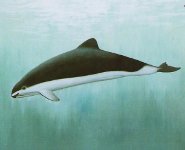
The Spectacled Porpoise has a distinctive coloring with a blue-black dorsal side and a white underbelly. Their black eyes are encircled by a striking white ring, or spectacle, which gives them their name. A black strip extends from the jaw-line to the flippers with the porpoise’s lips also being black in color. A white stripe runs along the top of their tail and their head is rather small and without beak. Their dorsal fin is large and rounded, and they have spade-shaped teeth.

The Spectacled Porpoise is a carnivorous animal that feeds mainly on squid and fish, but also eats octopus, shrimp, and mollusks. Behavior of the porpoise is little known as most of the findings have been taken from stranded individuals, but they are known to live in groups of up to 25 specimens, and they are fast active swimmers who normally avoid boats. Human interaction has been limited, because of their rare encounters, so much of the relationship between man and this species of porpoise is unknown, however it should be noted that they are already shy and may be fearful rather than curious toward any human invaders (contrasted with bottlenose dolphins which are very curious toward man). Another side-effect of being rarely observed is little knowledge of the animal’s reproductive biology, but calving is believed to take place from late winter to early spring. The total population of the species is unknown but it is believed to be threatened – however because of this lack of census for their population they are listed under the DD (Data Deficient – meaning not enough is known) category of the IUCN’s (International Union for the Conservation of Nature and Natural Resources) Conservation List. Efforts are still underway to attempt to track and find out just how many there are, how healthy they are, and if they need international protection from the IUCN.

Interesting Fact: The southernmost sighting was in the Drake Passage at 58° S which is the area of water between Antarctica and South America at South America’s southernmost point and Antarctica’s northernmost point.

Drawing of the spectacled porpoise by Alessio Marrucci of the Swiss Cetacean Society, 2007, licensed under GFDL

Tags used in this posting

,

Other entries about 'whale'


one comment:

cool!!!!!!!!!!!!!!!!!
leah (Email) - 06 05 09 - 00:11

You can help spreading the word about this animal by stumbling it by pressing this link StumbleUpon or
  
Remember personal info?

Emoticons / Textile

To be able to comment you are asked to answer this silly question. This question baffles automated spam bots, but fortunately for you it is a simple question, i hope.
 

  ( Register your username / Log in )

Notify:
Hide email:

Small print: All html tags except <b> and <i> will be removed from your comment. You can make links by just typing the url or mail-address.
Animal of the Day
Subscribe to the
animal of the day
Enter your Email


Powered by FeedBlitz

Add "Animal of the day" to your blog

A new feature has been set up for your
site: "Animal of the Day", you can add this to your website by copying the code. An example of how
this would look like and the code to be added can be found here.

63 comments - Permanent Link