
 |
 |
 |
 |
 |
 |
 |
 |
 |
 |
 |
Indian Peafowl
The Indian Peafowl is a resident breeder in the Indian subcontinent and has been introduced into many parts of the world; feral populations exist in many countries.
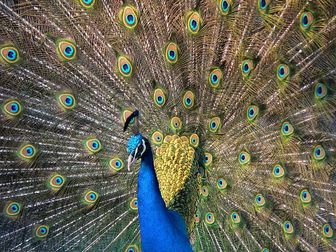
Original source: Photo taken by user BS Thurner Hof
Author: BS Thurner HofPermission(Reusing this file)I, the copyright holder of this work, hereby publish it under the following licenses:Permission is granted to copy, distribute and/or modify this document under the terms of the GNU Free Documentation License, Version 1.2 or any later version published by the Free Software Foundation; with no Invariant Sections, no Front-Cover Texts, and no Back-Cover Texts. A copy of the license is included in the section entitled GNU Free Documentation License.www.gnu.org/copyleft/fdl.htmlGFDLGNU Free Documentation Licensetruetrue
Permission: GNU Free Documentation License
Peacock - Beautiful and loud
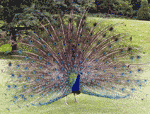 The Peacock (Pavo cristatus), which is also known as the Indian peafowl, has been part of the livestock of parks and gardens around the world for a long time. The large males are among the most beautiful gallinaceans, due to their shimmering blue plummage, their feather crowns and their about 150 long tail feathers with lots of eye marks, which they put up fanlike when performing their courtship display. The Peacock often is regarded as a domestic animal, whose feather fan is an artificial product of selective breeding. Surely there are a lot of Peacocks, which have been kept in parks and gardens for numerous generations, already showing signs of domestication, but most of them are not very different compared with their wild living relatives, which have got the same magnificent plummage. In the wild Peacocks inhabit lowlands and foothills in India and on Sri Lanka. They prefer park-like landscapes with a lot of bushes, which they use as refuges when in danger. Even a male Peacock with its magnificent plummage is able to fly up very quickly and hide in bushes or on a tree.
Free living Peacocks are quite timid birds. With good reason; they are very desired by Leopards and Tigers. Peacocks are always on their guard against the big cats they share the habitat with. They are also hunted by man because of their meat. But Peacocks living in parks and gardens get tame very soon. In India they have been kept in captivity for about 3000 years as ornamental birds but also as animals for slaughter. Peacocks also play an important role in Indian mythology. Very impressing, but not easy to bear for human ears, are the Peacocks' loud calls. They perform their bloodcurdling calls during the day as well as during the night, particularly often in the rainy season, since the Peacock's mating season coincides with that period. The males show much courtship behaviour at that time and display their feather fans to the peahens. Best prospects will have those Peacocks, which have the best to offer; most attractive towards peahens seem to be applicants with a lot of eye marks on their tail feathers.
The closest relative of the Peacock is the Green peafowl (Pavo muticus). Both species are very similar but the Green peafowl wears a more colourful plummage at its head. Its natural habitat is further in the east - in Burma, Thailand, Indochina, on the Malayan peninsula and on Java. Another Peacock relative, the Congo peacock (Afropavo congensis) inhabits the rainforests of the eastern and central Congo basin in Africa. Very special about the Congo peacock is the fact that it has been discovered not until 1936.
This article was originally published at magazine.naturspot.de. Link to the original article
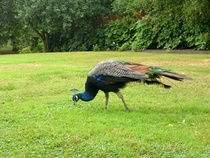
The Indian Peafowl is classified as Least Concern. Does not qualify for a more at risk category. Widespread and abundant taxa are included in this category.
Permission: Some rights reserved
Family : Phasianidae
Genus : Pavo
Species : cristatus
Authority : Linnaeus, 1758