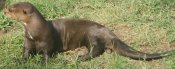
 As its name indicates, the giant otter (Pteronura brasiliensis) is the largest otter in the world. Its body length can reach up to 1.4 m while its tail alone can grow to be 30 cm to 100 cm. The average weight of an adult giant otter can reach up to 34 kgs. The males are larger than the females.
 The giant otter's feet have been adapted for their amphibious life. They have strong claws and big webbed feet, and its under-fur is water-repellent. The giant otter is extremely dark brown, almost black in color, except for a distinctive white spot at the throat's area. The giant otter lives in the larger rivers of the tropical rainforests in South America, preferring the slower rivers where vegetation is thick at the banks. To avoid their predators, the puma and jaguar, giant otters avoid bare ground, when possible, and prefer to live in areas with a large amount of vegetation.
In the past, the giant otter’s range was from Venezuela to northern Argentina; however, currently they are found only in Guyana and Brazil. Giant otters are social and live in groups, called holts. The holts are territorial. A giant otter holt consists of family members, typically siblings. The entire holt will help to rear the young and defend their territory.
Giant otters subsist primarily on fish, particularly catfish and perch.
Interesting fact: This otter is able to eat six to nine pounds of food in a single day.
Picture of the Giant otter by Renaud d'Avout d'Auerstaedt (http://renaud.davout.org/), licensed under Attribution ShareAlike 2.5
The Giant brazilian otter, giant otter is listed as Endangered (EN), considered to be facing a very high risk of extinction in the wild, on the IUCN Red List of Threatened Species
Namings for the giant otter
A young / baby of a giant otter is called a 'pup or whelp'. A giant otter group is called a 'romp, bevy, lodge, family or raft'.Countries
Bolivia, Brazil, Colombia, Ecuador, French Guiana, Guyana, Paraguay, Peru, Suriname and VenezuelaGiant otter habitats
Artificial / Aquatic & Marine, Artificial / Aquatic - Aquaculture Ponds, Artificial / Aquatic - Canals and Drainage Channels, Ditches, Artificial / Aquatic - Ponds (below 8ha), Bogs, Marshes, Swamps, Fens, Peatlands, Coastal Freshwater Lakes, Estuaries, Forest, Freshwater Springs and Oases, Marine Coastal / Supratidal, Marine Neritic, Permanent Freshwater Lakes (over 8ha), Permanent Freshwater Marshes / Pools (under 8ha), Permanent Rivers / Streams / Creeks (includes waterfalls), Seasonal / Intermittent Freshwater Lakes (over 8ha), Seasonal / Intermittent Freshwater Marshes / Pools (under 8ha), Seasonal / Intermittent / Irregular Rivers / Streams / Creeks, Shrub Dominated Wetlands, Subtropical / Tropical Mangrove Vegetation Above High Tide Level and Wetlands (inland)Some facts about the
Giant otter
Adult weight : 24 kg (52.8 lbs)
Maximum longevity : 17 years
Female maturity :730 days
Gestation : 68 days
Weaning : 122 days
Litter size : 2
Litters per year : 1
Weight at birth : 0.204 kg (0.4488 lbs)

Custom Search