Monday 31 May 2010
Bay Cat

The
Bay Cat (
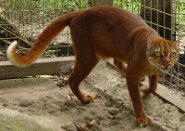
Catopuma badia) is a native of Borneo an island in southeast Asia south of the Philippines. It lives in rocky outcrops up to 900 metres and in dense tropical forests. It is so rarely seen that its habitat is not 100% confirmed but it is generally believed to be in the northern part of Borneo mainly in the Sabah and Sarawak and Kalimantan regions. It usually has reddish brown fur but there are also some with gray fur with paler fur on the stomach and chest and rounded ears. Bay Cats are approximately 22 inches or 55 cm long with an extra long 14 inch or 35 cm tail. They only weigh about 2.3 to 4.5 kg or 5 to 10 lbs.
The only other member of the genus Catopuma is the
Asian Golden Cat (catopuma temminckii) and the Bay Cat was thought to be a sub-species or separate version of the same cat but the blood samples taken from a specimen captured 1992 proved it to be a unique species. It is considered to be very endangered that is why it is protected everywhere it is thought to live.
Even though it is a small cat, little bigger than a domestic cat, it is considered very vicious and will attack an animal bigger than itself. Like most cats the Bay Cat hunts for its food at night including
rodents, monkeys and
birds, but will also scavenge and eat carrion. So little is known about this cat because there have been only 6 specimens between 1885 and 1928. The seventh was collected in 1992 and one in 1998 but there are still occasionally sightings. Everything known is based on these eight cats.
The Bay Cat is considered to be a mystery cat since it is so rarely seen or even photographed. It has one unusual feature about its teeth. They are not like any other cats teeth. The first upper premolar is smaller than normal with a rounded head and has only one root in the gum. Other cats have two roots.
Due to major habitat loss in Borneo the Bay Cat was reclassified in 2005 as endangered by the International Union for Conservation of Nature. Borneo has three wildlife reserves in existence but they are being invaded by people settling as well as logging. Zoos will pay a lot of money for a live specimen but so far none are officially in captivity.
Picture of the bay cat by Jim Sanderson, licensed under
Creative Commons Attribution-Share Alike 3.0 Unported license.
You can help spreading the word about this animal by liking it on facebook
Permanent Link
Tuesday 25 May 2010
The Tundra Swan - Tough Arctic Resident with an Incredible Migration

The
Tundra Swan/Whistling Swan (
Cygnus columbianus) is an all-white bird of amazing grace and beauty. Its bill is black, sometimes with a yellow spot at the base. The legs and feet are also black. While both genders are identical in appearance, the male is usually just a bit larger.
Measurements for both sexes are as follows:
Length: 47.2-57.9 in/120-147 cm
Wingspan: 66.1 in/168 cm
Weight: 134-370.4 oz /3800-10500 g
Although this animal is more commonly called the Tundra Swan, it has also been known as the Whistling Swan. This does not refer to the call of the bird - which is a low, melodic sound. Instead, it refers to the sound the bird’s powerful wings make in flight.
The migration of this swan is an incredible 3,725 miles (6,000 kilometers) round trip. True to its name, it breeds in the wet and cold Arctic tundra. The eastern population then heads to the Chesapeake Bay and North Carolina while the western population winters in primarily in California.
Tundra swans are believed to mate for life. They choose their mates for up to a year before breeding and the pair reinforces its bond through visual and vocal displays. While these animals flock together during migration, they are solitary nesters, often choosing a site near a pond, slow-moving river, or stream. The nest is assembled from a variety of plant material including sticks, moss and sedges. An excellent nesting site may be used year after year by the same birds.
The female usually lays four to five eggs and incubates them for about a month with some help from the male. After the eggs hatch both parents tend to the young swans and lead them to food sources. Although the young can fly at two to three months of age, they usually stay with the parents through the first winter.
The two parents are formidable opponents for most predators. Usually they can defend their nests against foxes and weasels. Larger predators like wolves, bears or even people will cause the parents to quickly leave the nest. This may still help to save the young as leaving quickly makes the nest more difficult to find.
The Tundra Swan population is very stable and hunting is allowed in some areas. The birds are very adaptable as well. Traditionally, the swan has primarily eaten aquatic roots and tubers, as well as shellfish. More recently these creatures have developed a taste for grains and corn, ensuring a well-fed, thriving population.
Picture of the Tundra swan by
Maga-chan, licensed under
Creative Commons Attribution-Share Alike 2.5 Generic
You can help spreading the word about this animal by liking it on facebook
Permanent Link
Sunday 23 May 2010
Woma - a Snake With a Neck

There are 2,900 species of snakes in the world, from the tiny thread snake to the mighty anaconda. They are revered and feared, pressed into service as companion animals and hunted for their meat and skin. Some, like the Woma snake, are endangered.
The Woma (
Aspidites ramsayi) is better known as the "Pit Python", but has a variety of other names as well. Depending on where they are found, they are known as Ramsey's python or sand python, and in areas where the Aboriginal people still live and hunt, they are called "jilajaku". Their habitat is the deserts of Western Australia.
There are several interesting features which makes the Woma unique. To begin with, though the average length of the Woma is 4.5 ft, or 1.5m, and their weight is approximately 5 kgs, or 11 lbs, they can range in size from mid-size to very large. The diversity of the Woma python's length and weight is based on the animal's age and diet. And diet depends on where they live and what is available. Some Womas live on small animals such as lizards and mice, but others live on larger mammals such as rats and other desert-dwelling rodents.
The other unique feature of this snake is its appearance. Unlike most snakes, the Woma python is a snake with a neck. The area just behind his head narrows enough to be quite noticeable, making it appear as if the snake has cervical vertebrae. It is a nocturnal animal, and it hunts in burrows in the desert dunes of Western Australia.
Finally, though this snake is a member of a species of snake called "constrictors" for the way they kill their prey, the Woma cannot actually wrap his body fully around the victim because they are in a burrow making it impossible for him to fully use his body. So, the snake pushes the victim against the side of the burrow, crushing it.
The Woma python is a favorite of Australians searching for their first pet snake because of its docile nature and simple needs. Though snake-keeping as pets is becoming more difficult as worldwide regulators are requiring special licenses for those who are hunting, transporting and offering them as pets. The Aboriginal people who live in Australia's outback still hunt them for their meat and skin, which is distinct and attractive. It's boldly colored bands and the appearance of a cervical area make it a favorite of herpetologists everywhere.
Picture of the Woma by Peter Halasz at Sydney Wildlife World, licensed under the
Creative Commons Attribution-Share Alike 2.5 Generic license
You can help spreading the word about this animal by liking it on facebook
Permanent Link