Subscribe to
"Animal of the day"

AddThis Feed Button
Or subscribe by e-mail

Enter your Email


Powered by FeedBlitz

We hope that reader will gain an increased appreciation of the need for more conservation measure in order to protect the beautiful creatures that inhabit the earth. Our philosophy is that the more we learn about animals, the more we respect them and take better care of them. That is why we update this blog with new animals, We encourage you to syndicate our content by adding "animal of the day" to your own blog! (read more)

About us

Our mission is to get people excited about animals and their welfare by writing articles on these animals. We encourage people to comment on posts and share with others. Don't forget to subscribe to our feed.

Contact us
Copyright notice

Cutest pet ever - cutest pet contest

Funny animal videos and pictures

Swimming with manatees - harmful or helpful

Last Comments

Tima (Bottlenose dolphi…): J. David Smith, Ph.D., a …
Coda Plant (Pudu - smallest d…): Hey. I live in Northern C…
Michael Newton (Koala video): i love you mr. koala
Tohru (Asian Golden Cat): I hate them too! They are…
tiffany (Asian Golden Cat): i love this cat i’m doing…
BK (Nubian Ibex - The…): Magnificent animal, espec…
amanda (Long-nosed cusima…): thhisanimal is so so so s…
misscrient (Muskrats - Water-…): Third paragraph last sent…
rudy (Deer Mouse - The …): that is so cool ilove lea…
Nick (Fattest cat in th…): “The cat is not over fed.…

Calendar

« November 2009
S M T W T F S
1 2 3 4 5 6 7
8 9 10 11 12 13 14
15 16 17 18 19 20 21
22 23 24 25 26 27 28
29 30          

Archives

Next Archive Previous Archive

01 Nov - 30 Nov 2009
01 Oct - 31 Oct 2009
01 Sep - 30 Sep 2009
01 Aug - 31 Aug 2009
01 Jul - 31 Jul 2009
01 Jun - 30 Jun 2009
01 May - 31 May 2009
01 Apr - 30 Apr 2009
01 Mar - 31 Mar 2009
01 Feb - 28 Feb 2009
01 Jan - 31 Jan 2009
01 Dec - 31 Dec 2008
01 Nov - 30 Nov 2008
01 Oct - 31 Oct 2008
01 Sep - 30 Sep 2008
01 Jul - 31 Jul 2008
01 Jun - 30 Jun 2008
01 May - 31 May 2008
01 Apr - 30 Apr 2008
01 Mar - 31 Mar 2008
01 Feb - 28 Feb 2008
01 Jan - 31 Jan 2008
01 Dec - 31 Dec 2007
01 Nov - 30 Nov 2007
01 Oct - 31 Oct 2007
01 Sep - 30 Sep 2007
01 Aug - 31 Aug 2007
01 Jul - 31 Jul 2007
01 Jun - 30 Jun 2007
01 May - 31 May 2007
01 Apr - 30 Apr 2007
01 Mar - 31 Mar 2007
01 Feb - 28 Feb 2007
01 Jan - 31 Jan 2007
01 Dec - 31 Dec 2006
01 Nov - 30 Nov 2006
01 Oct - 31 Oct 2006
01 Sep - 30 Sep 2006
01 Aug - 31 Aug 2006
01 Jul - 31 Jul 2006
01 Jun - 30 Jun 2006
01 May - 31 May 2006
01 Apr - 30 Apr 2006
01 Mar - 31 Mar 2006
01 Feb - 28 Feb 2006
01 Jan - 31 Jan 2006
01 Dec - 31 Dec 2005
01 Sep - 30 Sep 2005
01 Aug - 31 Aug 2005
01 Jul - 31 Jul 2005

Animal posters
Animal pictures
Mammals.start4all.com
Animal diversity web
Recently extinct animals forum
PetLvr.com
Another chance to see
Happiness is a warm puppy

Miscellany

AddThis Feed Button

Monday 09 June 2008 Northern river otter
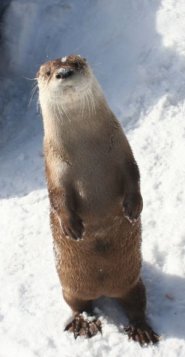
Northern river otterWeight: 5 to 14 kg (11 to 31 lbs)
Body length: 89 to 130 cm (35 to 51 in)

The Northern River Otter (Lontra canadensis), also known as North American River Otter, is a common sight in the waterways of North America, where it can be found in the Pacific Northwest, Alaska, Canada, the Atlantic states, and the Gulf of Mexico. They are active by day and have a streamlined, bulky physique, possessing short legs, a long tail and webbed digits. Northern River Otters have rounded, small heads and large whiskers. Their ears and nostrils are valved to keep out any water when submerged. Their pelage is shiny and brown in color, but usually, their throat is silver-gray in appearance. Not surprisingly, Northern River Otters are strong swimmers and can also move fast on land and are fond of sliding down along riverbanks all the way to the water.

In the wild, they can become ten to fifteen years of age, and under captivity, 20 years is possible.

It is very flexible animal, a Northern River Otter is capable of surviving in many kinds of habitats, such as freshwater, coastal marine, inland wetlands and even marshes. They can bear with differing ranges of temperature and altitudes, but they should be able to have access to two crucial things. First is a consistent supply of food, second is the proximity of water. Their diet consists of wide variety of things found in the water, including fish, crabs, amphibians, turtles, crayfish and other invertebrates. They can supplement their diet with birds and eggs and aquatic plants.

Akin to its cousin otters, this particular otter resides in a den, and this "home" is made in hollows, like under logs. It is recorded that they kill beavers to "conquer" their residences. These otters are playful, they slide, swim, chase, wrestle and leap. It makes them favorites to look at in zoos. They are not particularly friendly to humans if brought up in captivity, especially when they reach sexual maturity and begin acting aggressive and defensive.

While not listed as nationally endangered, they are endangered in states. Over 30,000 otter pelts are sold each year in the United States and Canada according to Wikipedia. They are also hunted by bobcats, coyotes, alligators, birds of prey and other large predators.

Interesting fact: When swimming in circles, it creating a whirlpool. This in turn forces the fish up to the surface.
You can help spreading the word about this animal by stumbling it by pressing this link StumbleUpon

four comments - Permanent Link

Monday 02 June 2008 Narrow-striped mongoose

Narrow striped mongooseBody length: 25 to 35 cm (9.84 to 13.78 in)
Weight: 640 gram (22.6 oz)

The range of the Narrow-striped Mongoose (Mungotictis decemlineata) is small and confined in the western and southwestern parts of Madagascar. They are diurnal creatures, spending a lot of time at the open savannas or in the trees, all dependent on the kind of season (dry or wet). In the summer (the wet season) they can be found sleeping in tree holes, while in the winter (the dry season) they are found in their burrows.

The fur of the Narrow-striped Mongoose is tawny in coloration, and the underside is noticeably light. It usually has about ten black stripes traversing the sides and the back. Their feet have no fur, but the Narrow-striped Mongoose has partially-webbed digits. It has a bushy, squirrel-like tail with dark rings.

Their diet mainly consists of insects and other small creatures, but they are known to eat eggs, rodents, birds and snakes, even a small lemur like the Gray Mouse Lemur! On the other hand, they are known to peacefully co-exist with another type of lemur, the Sportive lemurs.

They spend a lot of their time inside their burrows or in the trees and they are competent swimmers. They are social creatures, and groups ordinarily are made up of close to a dozen members, and we are not only speaking of family groups here, they also have maternal groupings and coalitions, this gives a whole new meaning to the term "political animal".

They are monogamous and a female individual is pregnant for about 3 months, after which she produces a single young.

They are an endangered species, this is because of fragmentation of their habitat, habitat loss (incl. logging), but also tavy, which is the name for the Madagascan slash-and-burn agriculture. The fossa is among their predators.

Interesting fact: Egg shells are not a problem for this "thinking" mongoose, it can crack them by taking the egg with all 4 paws while laying on its side, and then throw (or push) the egg against a hard object.

Picture of the narrow-striped mongoose is taken by Grigory Morozov in Tsimanampetsootsa National Park, October 2007, licensed under CC Attribution-ShareAlike 3.0
You can help spreading the word about this animal by stumbling it by pressing this link StumbleUpon

Add your thoughts about this animal - Permanent Link


Animal of the Day
Subscribe to the
animal of the day
Enter your Email


Powered by FeedBlitz