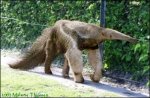
 The Giant Anteater (Myrmecophaga tridactyla) is the largest of the anteaters and lives Central and South America. Its diet consists mainly of ants and termites. Sometimes it feeds on up to 30,000 in a single day, moving from one anthill or temitehill to another. They do not have any teeth, even when reaching adulthood. The only mammals that has no teeth too, when mature, are the Pangolins. The middle three digits on their forefeet have longer claws, which they use to break open mounds of ants and termites. Actually they have five digits, despite their name 'tridactyla', which means 'three fingers' in Greek, the two outer digits are much smaller. The Giant anteater is the mammal with the longest tongue in relation to its body and can extend it as much as 150 times per minute and as long as 61 centimeters. They do not use their claws to digg burrows, yet they sleep in dense vegetation, abandoned burrows, or a hole in the ground. They are hunted on by jaguars and pumas, but their primary threat is habitat destruction. Giant anteaters are listed as 'vulnerable' by the IUCN.
 Picture of the giant eater by Malene Thyssen, www.mtfoto.dk/malene/, licensed under Creative Commons Attribution ShareAlike 2.5
Which zoos have them?
Artis (Netherlands), Birmingham Zoo (United States), Brookfield Zoo (United States), Saint Louis Zoological Park (United States) and Smithsonian National Zoological Park (United States)The Giant anteater is listed as Near Threatened (NT), is close to qualifying for or is likely to qualify for a threatened category in the near future, on the IUCN Red List of Threatened Species
Namings for the giant anteater
A young / baby of a giant anteater is called a 'pup'.Countries
Argentina, Bolivia, Brazil, Colombia, Costa Rica, Ecuador, French Guiana, Guatemala, Guyana, Honduras, Nicaragua, Panama, Paraguay, Peru, Suriname, Uruguay and VenezuelaGiant anteater habitats
Dry savanna, Forest, Grassland, Savanna, Shrubland, Subtropical / Tropical Dry Grassland, Subtropical / Tropical Dry Shrubland, Subtropical / Tropical High Altitude Shrubland, Subtropical / Tropical Moist Lowland, Subtropical / Tropical Moist Montane and Subtropical / Tropical Moist ShrublandSome facts about the
Giant anteater
Adult weight : 28.5 kg (62.7 lbs)
Maximum longevity : 31 years
Female maturity :1186 days
Male maturity : 1186 days
Gestation : 184 days
Weaning : 56 days
Litter size : 1
Litters per year : 1
Weight at birth : 1.6 kg (3.52 lbs)
Basal metabolic rate : 15 W
Body mass : 30.6 kg (67.32 lbs)
Temperature : 32.85 °C (91.13 °F)

Custom Search