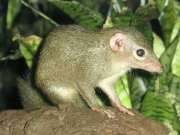
 The Common Treeshrew (Tupaia glis) has a long nose, and unlike squirrels, no long black whiskers. The Common Treeshrews differ from their relatives, as their tails are layered with long hair, they have an area of naked skin just above the nose, and an earlobe that is tinier than the ear's top area. The colors of the upper body could be any of a multitude of hues, such as red, ochre, brownish, olive and dark- but not exaxctly black, just dark.
They are diurnal creatures, but they use the bulk of the time at the ground and bush areas. Hungry or not, they are on search for food, constantly. Their diet comprises of insects, leaves and fruits. If a Common Treeshrew is eating, it would settle on its haunches, then manage the food via its front paws- very much like a squirrel. The social group is usually made up of a male, and he is accompanied by one to three females, but that's only a norm. A territory is well-set with both sexes interacting.
Their breeding occurs all throughout the year, and the litter size is can range from 1 to 3. The young are kept in an isolated place, and the parents just visits them to do feeding. Typically, sexual maturity of this shrew is attained at three months of age, for both genders.
Picture of the common treeshrew by User:Stavenn, licensed under GFDL
The Common tree shrew is listed as Least Concern (LR/lc), lowest risk. Does not qualify for a more at risk category. Widespread and abundant taxa are included in this category, on the IUCN Red List of Threatened Species
Some facts about the
Tree shrew
Adult weight : 0.2 kg (0.44 lbs)
Maximum longevity : 12 years
Female maturity :90 days
Male maturity : 90 days
Gestation : 46 days
Weaning : 36 days
Litter size : 2
Interval between litters : 45 days
Weight at birth : 0.013 kg (0.0286 lbs)
Weight at weaning : 0.1 kg (0.22 lbs)
Basal metabolic rate : 1 W
Body mass : 0.123 kg (0.2706 lbs)
Temperature : 36.85 °C (98.33 °F)

Custom Search