
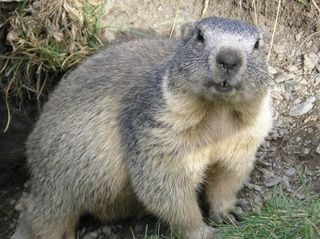
Alpine marmot
Order : Rodentia
Suborder : Sciurognathi
Family : Sciuridae
Subfamily : Sciurinae
Species : Marmota marmota
The Alpine marmot is listed as Least Concern (LR/lc), lowest risk. Does not qualify for a more at risk category. Widespread and abundant taxa are included in this category, on the IUCN Red List of Threatened Species
Some facts about the
Alpine marmot
Adult weight : 3.5 kg (7.7 lbs)
Maximum longevity : 17 years
Female maturity :730 days
Male maturity : 730 days
Gestation : 35 days
Weaning : 47 days
Litter size : 4
Litters per year : 1
Interval between litters : 914 days
Weight at birth : 0.03 kg (0.066 lbs)
Facts about the alpine marmot
Marmota marmota is one of eleven species of the genus Marmota which (Full text)
Marmota marmota is described for the first time as an intermediate host for Echinococcus multilocularis.
The marmot (Marmota marmota) is a curious and lively fur-ball that runs, plays, and gobbles close to the burrows when it isn't hibernating during the
The Alpine Marmot, Marmota marmota, is also making a real come back here.
The marmot Marmota marmota is common in the Alps and generally burrows above the tree-line, often amid the further protection of rocks.
Abstract - Marmota marmota is widely distributed in the study area.
De alpenmarmot (Marmota marmota) is een knaagdier uit het geslacht van de marmotten (Marmota) van de familie van de eekhoorns. (Wiki)
Abstract The Alpine marmot Marmota marmota is a territorial rodent.
Sõt, ha szerencsénk van mormotákat (Marmota marmota) is megfigyelhetünk. (Full text)
Standing upright and vigilantly guarding one of the many entrances to its immense burrow system, the Alpine Marmot is wary of any intruders. (Full text)
The Alpine marmot is active during the day, when it feeds on grass, herbs, roots and berries. (Full text)
The Alpine Marmot is found throughout mountainous Europe, from the Carpathians to the Alps and Dolomites.
The alpine marmot is found in Europe, while other species are in North America and Asia.
Alpine marmot is a hunting game under precise conditions.
The alpine marmot is part of the beared vulture' (Gypaetus barbatus) dietin the Pyrenees.
The Alpine marmot is everyone's favourite.
The 'Great Alpine Marmot' is quite heavy and slow, but will have a great ARM to compensate, and the dwarven rider is packing some serious ordnance.
The Alpine marmots are one of the biggest rodents.
Marmota marmota: Alpine Marmot Alpine Marmots are distributed throughout the Alps, Carpathians, Pyrenees and Tatra mountains of Europe where they live in grazed sub-alpine pastures and the higher elevations of alpine regions.
Survival of floaters and residents Floating alpine marmots are forced to live in unsuitable habitat that lacks shelter or is difficult to scan for predators, e.
Populations have grown and spread and alpine marmots are now common in the Pyrenees.
The Alpine marmots are said to act in concert in the collection of materials for the construction of their habitations.
Alpine Marmots are common here and we may be fortunate to see Ibex, which roam freely over the rocky summits.
Alpine Marmots are seen by ski areas.
More animals beginning with A