
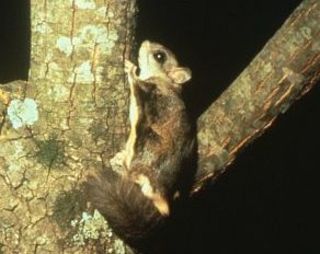
Northern flying squirrel
Order : Rodentia
Suborder : Sciurognathi
Family : Sciuridae
Subfamily : Pteromyinae
Species : Glaucomys sabrinus
Keywords: nocturnal
The Northern flying squirrel is listed as Least Concern (LR/lc), lowest risk. Does not qualify for a more at risk category. Widespread and abundant taxa are included in this category, on the IUCN Red List of Threatened Species
Namings for the northern flying squirrel
A young / baby of a northern flying squirrel is called a 'pup, kit or kitten'. The females are called 'doe' and males 'buck'. A northern flying squirrel group is called a 'dray or scurry'.Some facts about the
Northern flying squirrel
Adult weight : 0.149 kg (0.3278 lbs)
Maximum longevity : 14 years
Female maturity :210 days
Gestation : 40 days
Weaning : 68 days
Litter size : 3
Litters per year : 1
Weight at birth : 0.006 kg (0.0132 lbs)
Weight at weaning : 0.04 kg (0.088 lbs)
Facts about the northern flying squirrel
Northern flying squirrels are found mainly in coniferous forests, but can also be found in deciduous and mixed coniferous/ deciduous forests.
FAMILY: Sciuridae STATUS: Endangered, Federal Register, July 1, 1985 DESCRIPTION: The northern flying squirrel is a small nocturnal gliding mammal some 26O to 3O5 millimeters (1O to 12 inches) in total length and 95-14O grams (3-5 ounces) in weight.
Fish and Wildlife Service has uncovered that the state's northern flying squirrels are uncharacteristically sharing habitat - even nesting quarters - with their look-alike cousin, the southern flying squirrel.
Habitat In Grey and Bruce Counties, Northern flying squirrels are found primarily in large, unbroken stands of mixed and coniferous forests.
In West Virginia, the northern flying squirrel is now known from 84 sites in higher elevations.
Northern flying squirrels are also endangered because roundworm is carried by the southern flying squirrel and is harmful to the northern flying squirrel.
Northern flying squirrels are brown or gray on top and have a creamy colored stomach.
Northern flying squirrels are important in the "great scheme of things" in that
Northern flying squirrels are relatively gregarious and are known to share nests; however, the spectacular winter nesting aggregations reported for the southern flying squirrel (up to 5O in a nest) are unknown for this species.
Scientific Name: Glaucomys Sabrinus Fuscus Nickname: Flying Rat The Virginia Northern Flying Squirrel is one of not many kinds of flying squirrels.
Since Glaucomys sabrinus is a lichen and mycorrhizal fungus consumer, it could obtain large quantities of certain contaminants concentrated by its food organisms (04).
The Carolina Northern Flying Squirrel is a nocturnal rodent that glides from higher to lower tree branches by using a blanket like membrane of furry skin stretched between its forelegs and hind legs.
The larger Northern flying squirrel (Glaucomys sabrinus) is Grey and Bruce County's only flying squirrel, and is commonly found throughout much of Canada's evergreen and mixed forests.
The northern flying squirrel (Glaucomys sabrinus) is much less common and highly restricted in its distribution.
The Northern Flying Squirrel (Glaucomys sabrinus) is one of two species of the genus Glaucomys, the only flying squirrels found in North America (the other is the Southern Flying Squirrel, G.
The northern flying squirrel is a nocturnal sciurid that inhabits coniferous and mixed coniferous-deciduous forests.
The Northern flying squirrel is found across the top of North America, from Alaska to Nova Scotia, south to North Carolina and west to northern California.
The Southern Flying Squirrel (Glaucomys volans) is very abundant and widespread while the Northern Flying Squirrel (Glaucomys sabrinus) is a rare resident in North Carolina, being found here only on the highest peaks in the cool spruce/fir forest zone.
The Northern Flying Squirrel (Glaucomys sabrinus) is one of two species of the genus Glaucomys, the only flying squirrels found in North America (the other is the somewhat smaller Southern Flying Squirrel, G. (Wiki)
The Northern Flying Squirrel is found in coniferous and mixed forests across the top of North America, from Alaska to Nova Scotia, south to North Carolina and west to northern California. (Wiki)
The Northern Flying Squirrel is from the order Rodentia. (Full text)
The northern flying squirrel is less carnivorous, and in winter relies on lichens and conifer cones, seeds, and buds for food, instead of stored nuts. (Full text)
Northern flying squirrels are no longer being found in their historic range. (Full text)
More animals beginning with N