
Original source: http://popgen.unimaas.nl/~jlindsey/commanster.html
Author: James Lindsey
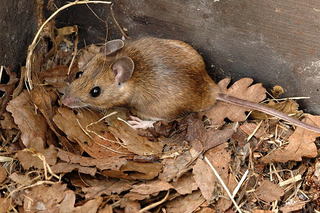
Yellow-necked field mouse
Order : Rodentia
Suborder : Sciurognathi
Family : Muridae
Subfamily : Murinae
Species : Apodemus flavicollis
Keywords: yellow
The Yellow-necked field mouse is listed as Least Concern (LR/lc), lowest risk. Does not qualify for a more at risk category. Widespread and abundant taxa are included in this category, on the IUCN Red List of Threatened Species
Namings for the yellownecked field mouse
A young / baby of a yellownecked field mouse is called a 'pinkie, kitten or pup'. The females are called 'doe' and males 'buck'. A yellownecked field mouse group is called a 'nest, colony, harvest, horde or mischief'.Countries
Albania, Andorra, Austria, Belarus, Belgium, Bosnia and Herzegovina, Bulgaria, Croatia, Estonia, Finland, France, Germany, Greece, Hungary, Israel, Italy, Latvia, Lebanon, Liechtenstein, Lithuania, Luxembourg, Macedonia, Netherlands, Norway, Poland, Romania, Russia, Serbia and Montenegro, Slovakia, Slovenia, Spain, Sweden, Switzerland, Syria, Turkey, Ukraine and United KingdomSome facts about the
Yellow-necked mouse
Adult weight : 0.029 kg (0.0638 lbs)
Maximum longevity : 5 years
Female maturity :52 days
Male maturity : 52 days
Gestation : 26 days
Weaning : 22 days
Litter size : 6
Litters per year : 3
Interval between litters : 39 days
Weight at birth : 0.002 kg (0.0044 lbs)
Weight at weaning : 0.009 kg (0.0198 lbs)
Body mass : 0.028 kg (0.0616 lbs)
Temperature : 36.85 °C (98.33 °F)
Facts about the yellow-necked field mouse
ABSTRACT The morphometric analysis of the microscopic structure of testes and epididymes in the rodent species Apodemus sylvaticus and Apodemus flavicollis is reported.
INTRODUCTION In Europe, the Yellow-necked Mouse (Apodemus flavicollis) is both abundant and wide-ranging; its distribution extends east into Russia, north into Scandinavia and south into Greece (Macdonald & Barrett, 1993; Mitchell-Jones
The serovar saxkoebing, which BORG-PETERSEN described in the year 1942 (1943) and isolated from the yellow-neck mouse (Apodemus flavicollis) is found in most European countries (KATHE and MOCHMANN, 1967), may, however not be found in some regions although its main reservoir, the yellow-neck mouse dwells, as SEBEK (1965) and SEBEK and ROSICKY (1974) drew attention to in Czechoslovakia .
Dobrava virus (DOBV) carried by Apodemus flavicollis is the causative agent of severe hemorrhagic fever with renal syndrome (HFRS). (Full text)
Investigations of the natural host of this virus indicate that the yellow-necked mouse, Apodemus flavicollis, is the most likely reservoir of Porogia virus 18 . (Full text)
yellow necked mouse (Apodemus flavicollis) is similar in appearance to the wood mouse, but it is larger, weighing up to 45g, and has a distinctive collar of yellow fur (see picture below). (Full text)
Apodemus flavicollis is a widespread species, known as a reservoir of some important tick-borne pathogens and is the preferential host of the juvenile stages of ticks. (Full text)
More animals beginning with Y