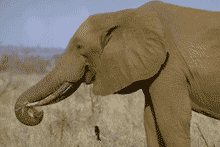
 Looking at an African elephant (Loxodonta africana) the first thing that becomes obvious is its huge size: African elephants are the largest mammals living on solid ground. They reach lengths up to 7,5 m and weights up to 7500 kg. Other characteristics are their large ears, the strong legs ressembling columns, the tusks, worn by males as well as females, and the trunk, of course. The trunk is kind of a multi-purpose tool. It is used to carry food and water to the mouth, to scent, to grope for things and as a tool to move things. It can also be used as a weapon. African elephants inhabit different parts of Africa south of the Sahara. But nowadays their distribution range is just one third of the area they inhabited in former times. They can be found in savannas as well as in forests, in semi-deserts and in mountain regions up to 5000 m height.
Keywords: tusk
Which zoos have them?
Brookfield Zoo (United States)The African elephant is listed as Vulnerable (VU), considered to be facing a high risk of extinction in the wild, on the IUCN Red List of Threatened Species
Namings for the African elephant
A young / baby of a African elephant is called a 'calf'. The females are called 'cow' and males 'bull'. A African elephant group is called a 'herd, flock, parade or memory'.Countries
Angola, Benin, Botswana, Burkina Faso, Burundi, Cameroon, Central African Republic, Chad, Congo, Democratic Republic of the, Congo, Republic of the, Cote d'Ivoire, Equatorial Guinea, Eritrea, Ethiopia, Gabon, Gambia, The, Ghana, Guinea, GuineaBissau, Kenya, Liberia, Malawi, Mali, Mauritania, Mozambique, Namibia, Niger, Nigeria, Rwanda, Senegal, Sierra Leone, Somalia, South Africa, Sudan, Swaziland, Tanzania, Togo, Uganda, Zambia and ZimbabweAfrican elephant habitats
Arable Land, Artificial / Aquatic & Marine, Artificial / Aquatic - Seasonally Flooded Agricultural Land, Artificial / Terrestrial, Bogs, Marshes, Swamps, Fens, Peatlands, Desert, Dry savanna, Forest, Freshwater Springs and Oases, Grassland, Hot Desert, Mediterranean-type Shrubby Vegetation, Moist savanna, Pastureland, Permanent Inland Deltas, Plantations, Rural Gardens, Savanna, Seasonal / Intermittent Freshwater Marshes / Pools (under 8ha), Seasonal / Intermittent / Irregular Rivers / Streams / Creeks, Shrub Dominated Wetlands, Shrubland, Subtropical / Tropical Dry forest, Subtropical / Tropical Dry Grassland, Subtropical / Tropical Dry Shrubland, Subtropical / Tropical Heavily Degraded Former Forest, Subtropical / Tropical High Altitude Grassland, Subtropical / Tropical High Altitude Shrubland, Subtropical / Tropical Mangrove Vegetation Above High Tide Level, Subtropical / Tropical Moist Lowland, Subtropical / Tropical Moist Montane, Subtropical / Tropical Moist Shrubland, Subtropical / Tropical Seasonally Wet / Flooded Grassland, Subtropical / Tropical Swamp, Temperate Desert, Temperate forest, Temperate Grassland, Temperate Shrubland and Wetlands (inland)Some facts about the
African elephant
Adult weight : 4800 kg (10560 lbs)
Maximum longevity : 65 years
Female maturity :4018 days
Male maturity : 3650 days
Gestation : 670 days
Weaning : 1071 days
Litter size : 1
Interval between litters : 1707 days
Weight at birth : 105 kg (231 lbs)
Weight at weaning : 600 kg (1320 lbs)
Mortality rate doubling time : 8 years
Links
Elephant links on the web
Nature's great masterpiece, an elephant. The only harmless great thing.
http://www.hedweb.com/animimag/eleplink.htm
Read about Elephant links at the Absolut Elephant
Elephant World
View big elephants living in zoos around the world, books, and read information on elephants.
http://www.spotlight.st/elephantworld/
Dieren - Beginthier.nl
Dutch site, categorizes animal site links.
http://dieren.beginthier.nl/
