
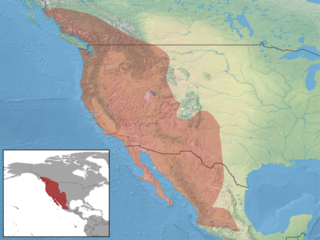
Original source: map data: http://www.naturalearthdata.com/downloads/ distribution data: http://www.iucnredlist.org/details/14213/0
Author: map data: Made with Natural Earth. Free vector and raster map data @ naturalearthdata.com.
Yuma myotis
Order : Chiroptera
Family : Vespertilionidae
Subfamily : Vespertilioninae
Species : Myotis yumanensis
The Yuma myotis is listed as Least Concern (LR/lc), lowest risk. Does not qualify for a more at risk category. Widespread and abundant taxa are included in this category, on the IUCN Red List of Threatened Species
Some facts about the
Yuma myotis
Adult weight : 0.006 kg (0.0132 lbs)
Maximum longevity : 9 years
Litter size : 1
Interval between litters : 365 days
Body mass : 0.005 kg (0.011 lbs)
Facts about the Yuma myotis
1996: Myotis yumanensis is expected, though not documented on the San Andres NWR, NM (Wiesenberger, 1996) *64*.
Duke DISTRIBUTION, ABUNDANCE, AND SEASONALITY The Yuma myotis is common and widespread in California.
Habitat The Yuma myotis is a medium-sized (head and body length, 38 - 49 mm) small eared (ear length, 11 - 14.
IDENTIFYING CHARACTERISTICS AND LIFE HISTORY: Myotis yumanensis is a small bat that is usually gray or brown to pale tan dorsally with a paler venter of tan or gray; ears and membranes are frequently pale brown to gray.
Range Myotis yumanensis is widely distributed in western Montana but is probably very limited in occurrence east of the Continental Divide (Hoffmann et al.
The Yuma myotis (Myotis yumanensis) is common along Big Chico Creek in the reserve and widespread in California.
The Yuma myotis is found throughout western North America, from British Columbia through Washington, Idaho, and western Montana, southern Wyoming, Colorado, New Mexico, West Texas and into Mexico.
The Yuma myotis is of similar size but is paler in color and the hairs lack metallic, burnished tips.
Yuma myotis (Myotis yumanensis) in flight with moth (#7 of 10) The Yuma myotis (Myotis yumanensis) is found throughout western North America, from British Columbia through Washington, Idaho, and western Montana, southern Wyoming, Colorado, New Mexico, West Texas and into Mexico.
Similar to most bat species, the Yuma myotis is primarily active at night, when foraging for insects, particularly small moths, occurs. (Full text)
The Yuma myotis, Myotis yumanensis, is a small bat that occurs in much of the western United States, as well as in southwestern Canada and much of Mexico. (Full text)
Yuma Myotis Myotis yumanensisHabitat: The Yuma myotis is associated with riparian lands of the western United States, although some of these areas may be relatively dry and shrubby. (Full text)
Fish and Wildlife Service as Threatened or Endangered Life History The Yuma myotis is described as having short rounded ears and a pointed tragus without (Full text)
Yuma Myotis ClassOrderFamilySpecies Mammalia Chiroptera Vespertilionidae Myotis yumanensis Yuma Myotis Distribution, Abundance, and Seasonality The Yuma myotis is common and widespread in California. (Full text)
Identification: Myotis yumanensis is a small bat that is usually gray (Full text)
Harvey & Associates San Jose, CAÂ 95118 Introduction The Yuma bat (Myotis yumanensis) is a small species (4. (Full text)
More animals beginning with Y