
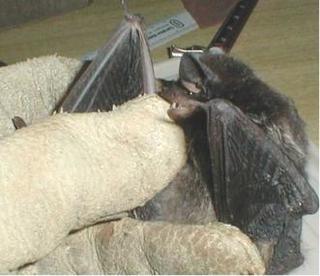
Silver-haired bat
Order : Chiroptera
Family : Vespertilionidae
Subfamily : Vespertilioninae
Species : Lasionycteris noctivagans
The Silver-haired bat is listed as Least Concern (LR/lc), lowest risk. Does not qualify for a more at risk category. Widespread and abundant taxa are included in this category, on the IUCN Red List of Threatened Species
Namings for the silverhaired bat
A young / baby of a silverhaired bat is called a 'pup'. A silverhaired bat group is called a 'colony or cloud'.Some facts about the
Silver-haired bat
Adult weight : 0.01 kg (0.022 lbs)
Maximum longevity : 12 years
Female maturity :152 days
Male maturity : 152 days
Gestation : 55 days
Weaning : 36 days
Litter size : 2
Interval between litters : 365 days
Weight at birth : 0.002 kg (0.0044 lbs)
Facts about the silver-haired bat
, with the possible exception of Florida, to extreme northern Mexico The silver-haired bat is a dark brown to black colored bat with tips of the fur silver in color.
Although the Silver-haired Bat is commonly regarded as a solitary tree-roosting bat, there are few reliable records.
Discussion Generally regarded as a solitary, tree-roosting species, the Silver-haired Bat is usually found roosting under a slab of bark or in some other protected spot, although there are a few records of it roosting among foliage.
Physical Description- Silver-haired bats are medium sized bats, weighing 8 to 12 grams.
Posted on Sunday, July 14, 2002 @ 00:15:15 PSTSilver-haired bat - Lasionycteris Silver-haired bats are among the most common bats in forested areas of America, most closely associated with coniferous or mixed coniferous and deciduous forest types, especially in areas of Old Growth.
Silver-haired bats are among the most common bats in forested areas of America, most closely associated with coniferous or mixed coniferous and deciduous
Silver-haired bats are one of the earliest bats to emerge as daylight ends and are believed to be one of the slowest-flying bats in North America.
Silver-Haired Bats are year-round residents in many regions.
The silver-haired bat (Lasionycteris noctivagans) is an insect-eating bat found
The silver-haired bats are migratory, and sometimes migrate in groups.
Silver-haired bats are medium sized bats, weighing 8 to 12 grams. (Full text)
The silver-haired bat is found through out the entire state of Virginia, as well as, throughout the United States. (Full text)
The silver-haired bat is a medium-sized bat with dark brownish-black fur. (Full text)
Today, the silver-haired bat is uncommon to rare throughout the Northeast. (Full text)
Because silver-haired bats are dependant upon roosts in these areas of Old Growth, managing forests for diverse age structure and maintaining forested corridors are very important to these bats‹³Increasing pressure to use resources from forests, especially those of older stands, has increased the urgency for identifying characteristics of trees and surrounding habitat that are important in determining suitable roosts (Full text)
The scientific name of the silver-haired bat is derived from Greek and Latin words meaning "Night wandering shaggy bat. (Full text)
The scientific name of the silver-haired bat is derived from Greek and Latin words meaning "Night wandering shaggy bat. (Full text)
647 rabid bats were reported from 46 states during 1992 the silver-hared bat (_Lasionycteris noctivagans_) is often implicated. (Full text)
Foraging Ecology: Silver-haired bats are slow, highly maneuverable flyers that rely on echolocation calls ideally (Full text)
Identification: Lasionycteris noctivagans is a medium-sized bat with (Full text)
Population Trends and Protection Status: The silver-haired bat is one of the most abundant bats in (Full text)
More animals beginning with S