
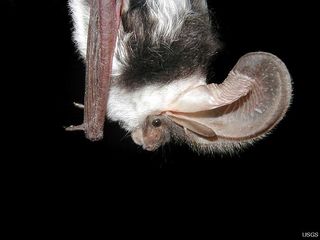
Spotted bat
Order : Chiroptera
Family : Vespertilionidae
Subfamily : Vespertilioninae
Species : Euderma maculatum
The Spotted bat is listed as Least Concern (LR/lc), lowest risk. Does not qualify for a more at risk category. Widespread and abundant taxa are included in this category, on the IUCN Red List of Threatened Species
Namings for the spotted bat
A young / baby of a spotted bat is called a 'pup'. A spotted bat group is called a 'colony or cloud'.
Facts about the spotted bat
The Spotted bat is so named for its three white spots located over each shoulder and on the rump.
1996: Euderma maculatum is expected, though not documented on the San Andres NWR, NM (Wiesenberger, 1996) *56*.
Another interesting habit of the Spotted bat is its hunting technique.
Apparently spotted bats are relatively solitary but may hibernate in small clusters (Easterla 1973); roosts and hibernacula are usually located in cliffs, and to some degree caves.
Barbour and Davis (1961:161) suggest that spotted bats are residents of the ponderosa pine area in June and July and wander to lower elevations in late summer and autumn.
Behavior: The spotted bat is rare, perhaps a relict species, and is known from only a few dozen specimens collected since its discovery in 1890.
FentonSpotted bats are more widespread than pallid bats, but they were only noticed in Canada in 1979.
Found in a patchy distribution from southern British Columbia to northern Mexico, spotted bats are elusive and seldom seen.
Meet Our Bats The Spotted Bat Euderma maculatum Back to Meet Some Bats The spotted bat is a large bat with striking markings.
Spotted bat (Euderma maculatum) roosting in rock crevice (#1 of 10) The spotted bat (Euderma maculatum) is one of America's most striking mammals.
Spotted Bat The Spotted Bat Euderma maculatum The spotted bat is a large bat with striking markings.
Spotted bats are believed to maintain exclusive foraging areas ranging from three to six miles from their day roost site from approximately an hour after sunset to an hour before sunrise.
Spotted bats are moth specialists.
Spotted bats are rare in Oregon and seen only on the east side of the state.
The spotted bat (Euderma maculatum) is one of North America's most beautiful bats.
The Spotted bat (Euderma maculatum) is one of the rarest and most beautiful mammals of North America, ranging from Mexico to western Canada.
The spotted bat (Euderma maculatum) is the only mammal species designated as threatened in Nevada.
The Spotted bat (Euderma maculatum) is undoubtedly the easiest American bat to identify with its black back sporting three large white spots and its huge pink ears, the largest ears of any American bat.
The Spotted bat (Euderma maculatum) is undoubtedly the easiest .
The spotted bat is one of America's most striking mammals.
The spotted bat, Euderma maculatum, is a large (16-20 gram), distinctively marked bat.
The spotted bat is named for three distinctive white spots on its black back. (Full text)
Male and female Spotted Bats are externally similar. (Full text)
Although unmistakable in appearance, the spotted bat is one of the least understood of American bats, primarily because of its relative scarcity, at least in collections. (Full text)
More animals beginning with S