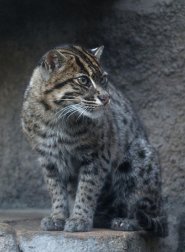
 Unlike popular belief, not all cats dislike water. The Fishing Cat (Prionailurus viverrinus), not to be confused with the Fisher, is a strongly-built cat, having short feet and a big head. Fishing Cats have a olive-gray pelage with black spots. The back has a pronounced white center spot. Akin to the flat headed cat, the claws are shortened, yet the Fishing Cat has less established teeth. They can be found in mangrove swamps, creeks, oxbow lakes and reed beds of Bangladesh, Bhutan, Brunei Darussalam, Cambodia, China, India, Indonesia (Java, Sumatra), Lao People's Democratic Republic, Malaysia (Peninsular Malaysia), Myanmar, Nepal, Pakistan, Sri Lanka, Thailand and Viet Nam.
 The gestation of the Fishing Cat is around 60+ days, the female Fishing Cats gives birth to one to four kittens. They eyes of the young open after the sixteenth day. Weaning is about 4 to 6 months old, and this young would attain adult size when it is around 9 months of age. At the tenth month, it would be independent from the parents.
Longevity of this cat in captivity is about 12 years on average. It is believed that they are loners, but there were observations that the male Fishing Cat is sometimes helping with the rearing of the newborns.
The Fishing cat is listed as vulnerable, they are threatened by hunting and habitat loss. Wetland areas have been cleared by humans to make room for farmland and road, also pollution from industries make Fishing cats sick. But there is hope, fishing cats appear to adapt well to suburban habitats.
Interesting fact: The Fishing Cat can use its short tail as a rudder while swimming.
Picture of the Fishing cat by Opencage, licensed under Creative Commons Attribution ShareAlike 2.5
Which zoos have them?
Smithsonian National Zoological Park (United States)The Fishing cat is listed as Vulnerable (VU), considered to be facing a high risk of extinction in the wild, on the IUCN Red List of Threatened Species
Namings for the fishing cat
A young / baby of a fishing cat is called a 'kitten'. The females are called 'queen' and males 'tom '. A fishing cat group is called a 'clowder, clutter, pounce, kindle (young), embarrassment (young),'.Countries
Bhutan, Brunei, Burma, Cambodia, China, India, Indonesia, Laos, Malaysia, Nepal, Pakistan, Sri Lanka, Thailand and VietnamFishing cat habitats
Forest, Permanent Freshwater Lakes (over 8ha), Permanent Inland Deltas, Permanent Rivers / Streams / Creeks (includes waterfalls), Subtropical / Tropical Mangrove Vegetation Above High Tide Level, Subtropical / Tropical Moist Lowland and Wetlands (inland)Some facts about the
Fishing cat
Adult weight : 10.65 kg (23.43 lbs)
Maximum longevity : 17 years
Gestation : 72 days
Weaning : 182 days
Litter size : 2
Weight at birth : 0.17 kg (0.374 lbs)

Custom Search