
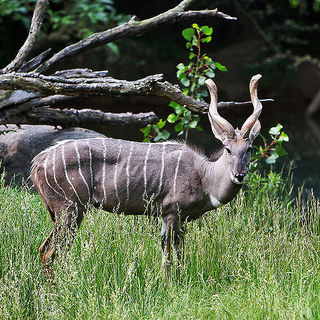
Original source: a posing lesser kudu
Author: Steve from washington, dc, usa
Lesser kudu
Order : Artiodactyla
Family : Bovidae
Subfamily : Bovinae
Species : Tragelaphus imberbis
Keywords: brown , white , stripe , mane , horn , nocturnal , crepuscular
The Lesser kudu is listed as Conservation Dependent (LR/cd), the focus of a continuing taxon-specific or habitat-specific conservation programme targeted towards the taxon in question, the cessation of which would result in the taxon qualifying for one of the threatened categories below within a period of five years, on the IUCN Red List of Threatened Species
Some facts about the
Lesser kudu
Adult weight : 82.5 kg (181.5 lbs)
Maximum longevity : 20 years
Female maturity :504 days
Male maturity : 504 days
Gestation : 235 days
Weaning : 274 days
Litter size : 1
Litters per year : 1
Weight at birth : 6 kg (13.2 lbs)
Facts about the lesser kudu
The Lesser Kudu, (Tragelaphus imberbis) is a beautiful animal with a brownish-red body and 15 delicate white vertical stripes on its back.
By contrast, lesser kudus are even smaller, about 42 inches at the shoulder; males weigh around 220 pounds while females generally weigh about 50 pounds less. (Full text)
The lesser kudu is similar in color to the greater, but measures only 90 to 105 cm (35 to 41 in) at the shoulder. (Full text)
Ecology and Behavior The lesser kudu is primarily active at night and in the early morning, seeking (Full text)
General Information: The Lesser Kudu is one of the most beautiful antelopes in Africa. (Full text)
Lesser kudus are originally from Africa (Somalia). (Full text)
More animals beginning with L